



It’s 2026, and it’s official — AI has moved past the “interesting experiment” phase and into a lived operational reality for legal teams. The conversation is now practical. Not whether legal should use AI, but what to prioritize, how to control risk, and how to make AI useful without turning the function into a science project.
Across industries, three priorities keep surfacing.
Priority one: Protection
AI introduces capability. It also introduces exposure.
Regulations like GDPR and the EU AI Act are only the starting point. Legal teams are accountable for how AI is deployed across contracts, research, compliance, and vendor ecosystems. Protection means defined controls, documented review processes, clear escalation paths, and audit-ready governance embedded directly into workflows.
LegalEase supports AI governance and privacy alignment with responsible implementation and human oversight built in by design.
AI in Legal needs rules.
ISO 27001:2022 certified
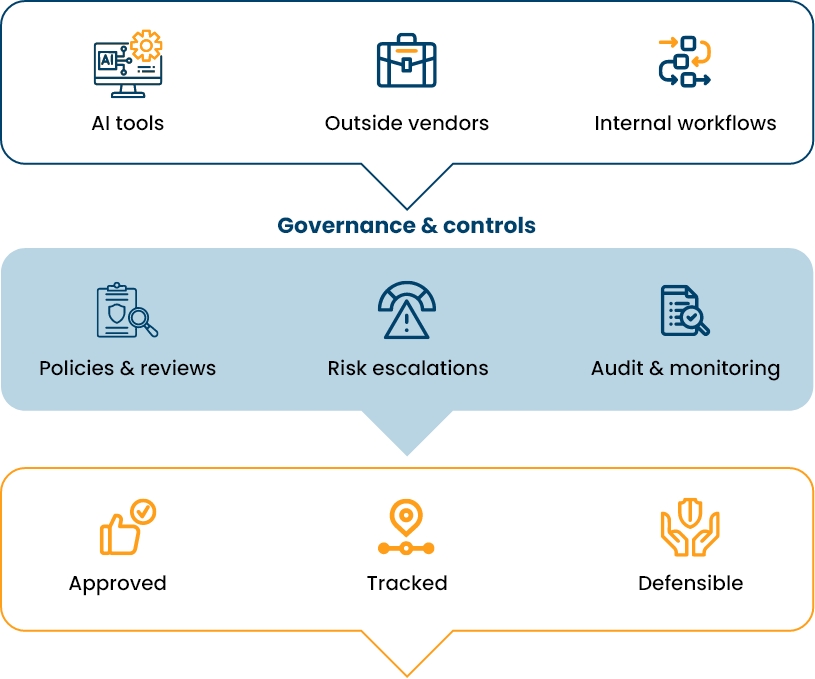
LegalEase Solutions operationalizes AI governance and privacy for GDPR, EU AI Act, and beyond
Priority two: Support
Work volume keeps rising — reviews, documents, data. Expectations keep tightening. Legal teams are under pressure to move faster without weakening risk standards. AI-assisted review helps, but only when structured through playbooks, fallback positions, and attorney oversight. The priority is consistency at scale, and needs the right human oversight to support accuracy.
LegalEase partners to tailor attorney-led, AI-powered contract review workflows designed around playbooks, risk matrices, and fallback positions.
Speed is great. Consistency is better.
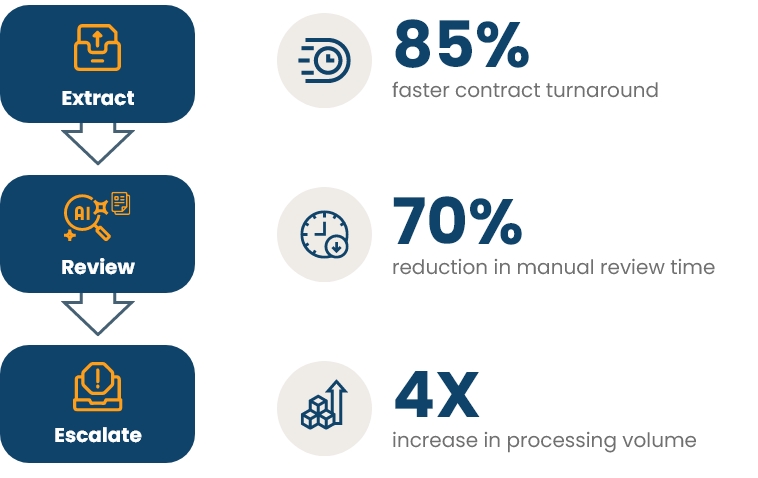
Attorney-led, AI-supported reviews built on playbooks, fallback positions, and clause-level rules.
Priority 3: Reasoning
AI can extract, cluster, summarize, and scan. It cannot think like a lawyer.
Hallucinated case law, shallow precedent analysis, and unsupervised eDiscovery workflows have already shown how quickly automation can become liability. The real priority for legal teams is defining the boundary between assistance and decision-making. Legal reasoning requires context, accountability, and experience.
Reasoning is not automated.
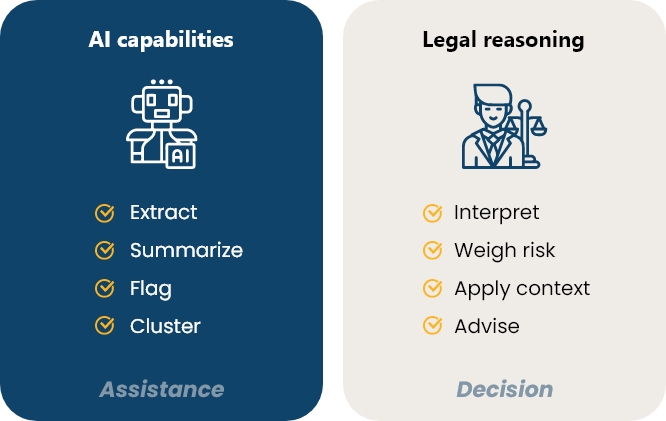
AI supports. Lawyers decide.
The bottomline is simple: AI only delivers value when it is protected by governance, strengthened by structure, and anchored in real legal reasoning.
That’s where LegalEase helps legal teams use AI with confidence — not as an experiment, but as disciplined infrastructure that keeps work predictable, defensible, and quietly under control.
Ready to explore attorney-led AI-powered legal solutions tailored to your business?