

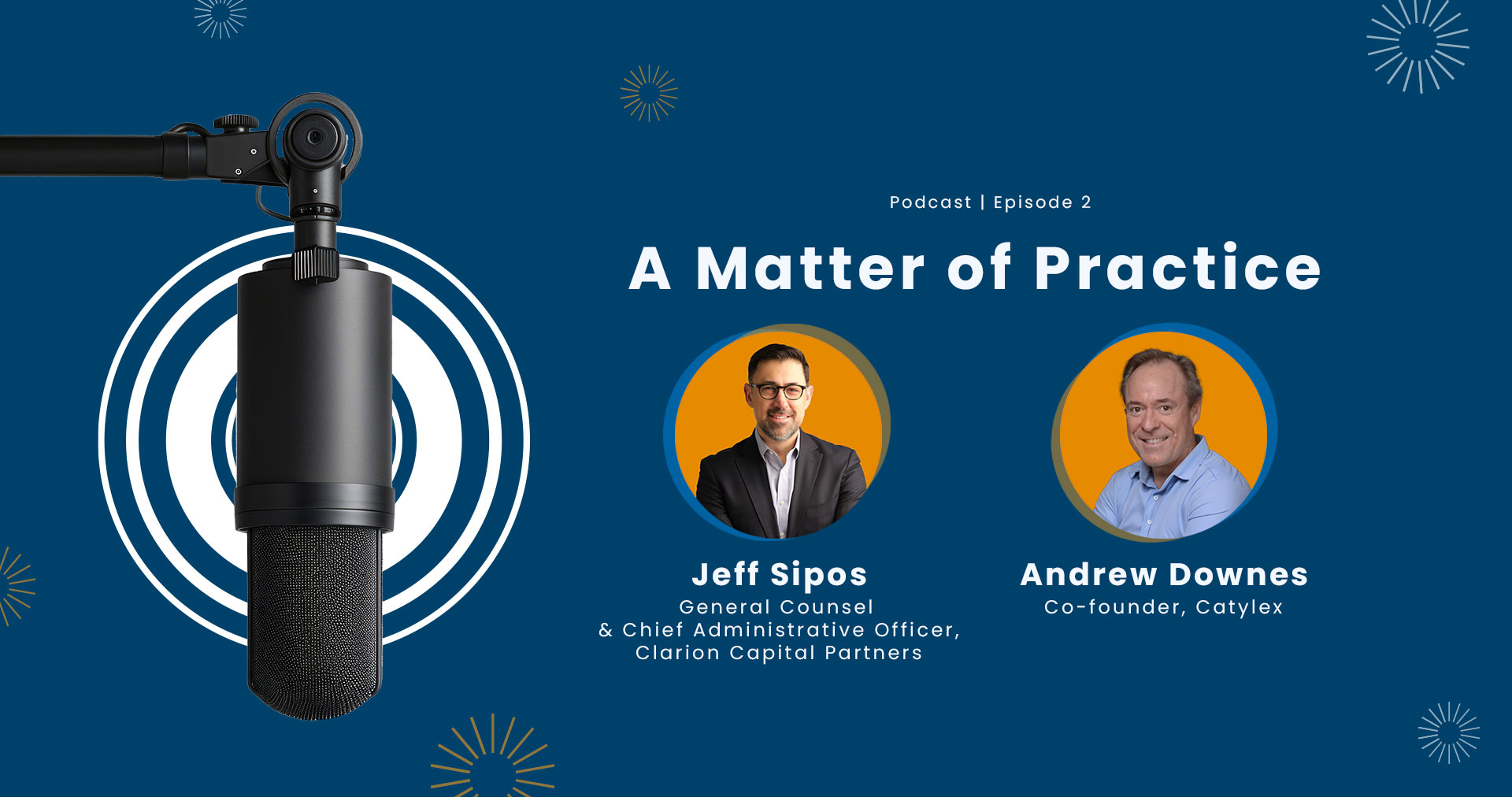
Private equity legal work rarely slows down because of lack of intent. It’s the NDAs, side letters, and LPAs that accumulate risk faster than teams can review them. In Episode 2 of A Matter of Practice, we sat down with Jeff Sipos, General Counsel at Clarion Capital, and Andrew Downes, Co-Founder of Catylex, a Contract Analytics Legal Tech company, alongside LegalEase Co-CEO Tariq Hafeez, to talk about where AI genuinely helps and where human judgment remains non-negotiable.
Here are the three key takeaways.
1. Speed is not optional in PE-backed companies
Legal teams in PE-owned businesses are often building process while the deal is already moving. As Jeff Sipos put it, “When you are in a fast-growing company, particularly one owned by PE, you need to be agile”. You must also be comfortable with spotting issues, and creating structure where none exists. Waiting for the perfect process is rarely an option.
2. Side letters and LPAs break down at scale
Andrew Downes described the reality many legal teams face when volume increases. At hedge funds, teams often extract “a very small portion of what we ultimately would need” from side letters, not because the rest is irrelevant, but because deep review is incredibly expensive. Important data stays untouched simply due to cost.
3. AI makes previously impractical work possible
At scale, AI changes the economics of legal review. “We can process a thousand 10 page documents an hour,” Andrew explained, turning what would be a multi-year, multi-million-dollar human effort into something achievable in days.
For Jeff, this is where AI earns its place: high-frequency legal tasks where a “there must be a better way of doing it” outlook comes together with technology and people to make legal work safer, faster, and more commercial.